top of page

Much of the food we share comes from donations from individuals and groups in our community. Throughout the year, we rely on others to bring food staples, holiday basics and even personal care items that are given to our client families.


Current Needs in the Food Pantry (updated 7/21/2025).

  • Snacks (8–12 servings)

  • Boxed potatoes and rice

  • Baking items

  • Kid’s Pull ups

  • Baby Wipes

  • Adult wipes

  • Moisturizing shampoo

  • Body wash (adults and kids)

  • Razors (men’s and women’s)


The Diocesan Outreach Endowment Fund was established as a result of the generosity of Missouri Episcopalians through pledges to the Making All Things New Capital Campaign.  Its purpose is to challenge congregations to make a difference where they are and to improve the quality of life in and with their communities, as well as to identify pressing social needs and design strategies to meet those needs.

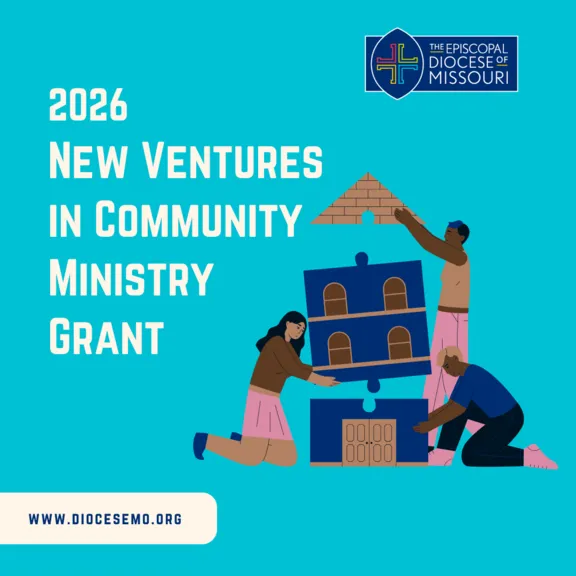
New Ventures in Community Ministries Grants are meant to support projects involving new ministries and new visions. These projects (which may include new aspects of existing programs, as well as entirely new projects) are to be doable, manageable, replicable, and sustainable by congregations.  Consideration will be given to projects that serve people from particular populations (aged, children, youth), or those suffering from poverty, loneliness, or other similar needs.

MISSION STATEMENT

The mission of the Diocesan Outreach Endowment Fund through the New Ventures in Community Ministries Grants is to inspire congregations to dare great things for God by developing new ministries and visions in response to changing social needs throughout the diocese.

The New Ventures in Community Ministries Grant Committee, established by the Diocesan Council, with the advice and consent of the Bishop and Diocesan Council, shall be responsible for the disposition of the income generated by the Diocesan Outreach Endowment Fund.


Timetable for Abstract and Formal Application Process

Week of June 16, 2025 -The Committee for New Ventures in Community Ministries Grant announces the process for applying for the grants. Application material is available from the Offices of the Bishop.

July 26, 2025 - Deadline for submitting Abstracts to the Committee, via the Offices of the Bishop.

August 12, 2025 - Notice of acceptance or regret regarding Abstracts.  Congregations are notified whether or not they should proceed to Phase II of the grant application.

September 13, 2025 - Deadline for submitting Formal Application.

September 28, 2025 - Committee receives advice and consent of the Bishop and Diocesan Council.

Diocesan Convention 2025 - The Bishop will announce the grant awards. Committee notifies congregations that did not receive awards before the convention.

Mid-January, 2026 - Grant money is available mid-January and distributed upon request.


Our Gospel reading in Luke this Sunday tells about Jesus teaching his disciples how to pray, and after teaching the “Lord’s Prayer” he reminds them to “…Ask, and it will be given you; search, and you will find; knock, and the door will be opened for you.”


Our Processional hymn will be How firm a foundation. It is a hymn that for over two centuries has assured believers of the faithfulness of Christ and the certainty of hope. The first verse acts almost as an introduction to the rest of the text, giving us cause to stop and ponder the Word of assurance that God has given us, described in greater detail in the next four verses. In the words of this hymn then, we carry with us the Word from God, and the call to trust in that Word. But God’s Word is expansive and not limited to letters on a page - the fifth verse moves us to a trust in the Word made flesh in Jesus Christ. We are assured by the words we sing, the Word we are given, and the Word made flesh, of the steadfastness of God’s unfailing love. It is sung to the Southern Harmony, Sacred Harp tune Foundation. (Hymnary.org)


The Sequence hymn, Forgive our sins as we forgive, describes Jesus’ teaching about the Lord’s Prayer. Rosamond E. Herklots (1905-1987) wrote these words in 1966 after digging out weeds in her garden in England, and thinking how bitterness, hatred, and resentment are like poisonous weeds growing in the Christian garden of life. "Forgive Our Sins" is a hymn about being ready to forgive others again and again-as Jesus said, seventy-times-seven times! We have many hymns about God's forgiveness of our sins, but this one adds a most helpful guide in forgiving others' sins. (Psalter Hymnal Handbook, 1988) This hymn uses another American tune from Kentucky Harmony called Detroit and was written by William Bradshaw in 1820.


We will have a guest baritone soloist this Sunday and one of my good friends: Ben Silvermintz. Ben is the Vocal Music Director at Parkway Central High School and has been my co-worker directing our five Choirs for the past 17 years. He recently became the Performing Arts Department Chairperson for Central also. He directs the High Holiday choir at Congregation Shaare Emeth each fall for Rosh Hashanah and Yom Kippur. We are so fortunate to have him sharing his voice on two anthems: The Lord’s Prayer, a classic solo by Albert Malotte, and Down to the River to Pray arranged by Jay Althouse, incorporating Down to the River and Jesus walked this Lonesome Valley. (Copyright 2006 Alfred Publishing Co)


Our final hymn, When You Are Praying, was written by Carolyn Winfrey Gillette, in an effort to put the Lord’s Prayer in a fresh context: “God give us all we daily need and we will be content; Forgive our sins as we forgive the wrongs that we resent.” She also addresses the idea of asking for help from God by saying, “O Lord, we turn in trust to you, You know the things we need, and like a parent, you so love: The ones who ask, receive.” (Copyright 1998 by Carolyn Winfrey Gillette, www.carolynshymns.com, used with permission)

St. Martin's Episcopal Church

15764 Clayton Rd, Ellisville, MO 63011

636.227.1484

SMEC logo.gif
  • Facebook
  • YouTube
  • X
  • Instagram
bottom of page